North America
United States El Niño 2026 outlook
Near average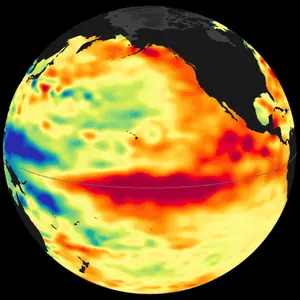
Seasonal outlook
October to December 2026
Likely close to usual
The European seasonal forecast model expects temperatures in the United States to stay close to usual for this time of year.
Estimated chance of each outcome. With no forecast signal, each would be about 1 in 3.
Technical details
- Model: ECMWF SEAS5 (system 51) ensemble mean, from the Copernicus Climate Data Store.
- 2 m air temperature anomaly: +0.21°C, averaged over October to December 2026, relative to the model's 1993 to 2016 average.
- Taken at the model grid point nearest 39.80, -98.60, so it represents that area rather than the whole country.
- Chances (cooler / about usual / warmer): 29% / 41% / 30%. Estimated by Niño Tracker from the size of the anomaly, because the ensemble mean product does not include the model's own odds.
- Confidence is set by the anomaly's size: under 0.5°C low, 0.5 to 1°C moderate, 1°C or more high.
El Niño right now
Very strong El Niño
El Niño is a natural warming of the central and eastern tropical Pacific Ocean that shifts weather patterns around the world. Over July to September 2026, sea temperatures there averaged about 2.2°C above normal, which counts as a very strong event.
Technical details
- Oceanic Niño Index (ONI): +2.16 for JAS 2026. It is the 3-month average sea surface temperature anomaly in the Niño 3.4 region (5°N to 5°S, 120°W to 170°W), from NOAA.
- El Niño conditions are +0.5°C or more, La Niña −0.5°C or less, sustained for five overlapping 3-month seasons. Strength: weak 0.5 to 0.9, moderate 1.0 to 1.4, strong 1.5 to 1.9, very strong 2.0 or more.
- NOAA now uses a relative version of this index (RONI) for official monitoring. The ONI is still published each month.
- Last updated Oct 23, 2026, 12:00 AM UTC.
Upcoming 7 Days
Washington, D.C.
- This week avg
- 13.9°
- Last year avg
- 10.4°
than the same week last year, on average.
Daily average
Temperatures in °C. Tap or hover the chart to compare each day.
Across these 8 cities, it averaged 16.2°, 2.1° cooler than this week's forecast of 18.3°.
Niño Tracker updates weather data two times a day.
El Niño and United States: common questions
How will El Niño affect the United States in 2026?
The European seasonal forecast model expects temperatures in the United States to stay close to usual for this time of year. The forecast covers October to December 2026. Only a slight lean, so treat it as a rough guide.
How does El Niño usually affect the United States?
Typical effects of past El Niño events in the United States: warmer and drier northern tier, cooler and wetter Gulf Coast and Southeast. Every event is different, so these are tendencies rather than guarantees.
How does La Niña affect the United States?
Typical effects of past La Niña events in the United States: colder northern tier, warmer and drier South. La Niña often pushes weather roughly the opposite way to El Niño.
What is the weather forecast for the United States this week?
Over the next 7 days, forecast lows and highs are: Washington, D.C. 5 to 21°C, New York 2 to 21°C, Los Angeles 13 to 30°C, Chicago 7 to 22°C, Houston 14 to 30°C, Phoenix 13 to 31°C, Miami 20 to 28°C and Seattle 3 to 15°C. Across these cities the average is 18.3°C. Last year the same week averaged 16.2°C, so this week is forecast to be 2.1°C warmer.
Is El Niño happening right now?
El Niño is a natural warming of the central and eastern tropical Pacific Ocean that shifts weather patterns around the world. Over July to September 2026, sea temperatures there averaged about 2.2°C above normal, which counts as a very strong event. El Niño continues to strengthen, with a strong-to-very strong El Niño likely through January-March 2027 (remaining greater than an 83% chance).